

Write this faster.
Summarize this faster.
Produce five versions instead of one.
Turn the same report around in two hours instead of two days.
Useful? Sure.
Transformational? Not even close.
That’s why this Think with Google article by David Edelman caught my attention: “The CMO factory problem: How AI can free marketing leaders to actually lead.”
The line that matters most is this:
“The mistake most organizations make with AI is treating it as an accelerant for the existing workflow.”
Exactly.
And I see the same thing happening in SEO, content, and marketing teams right now.
People take the same process they’ve always had, add AI somewhere in the middle, and call it innovation.
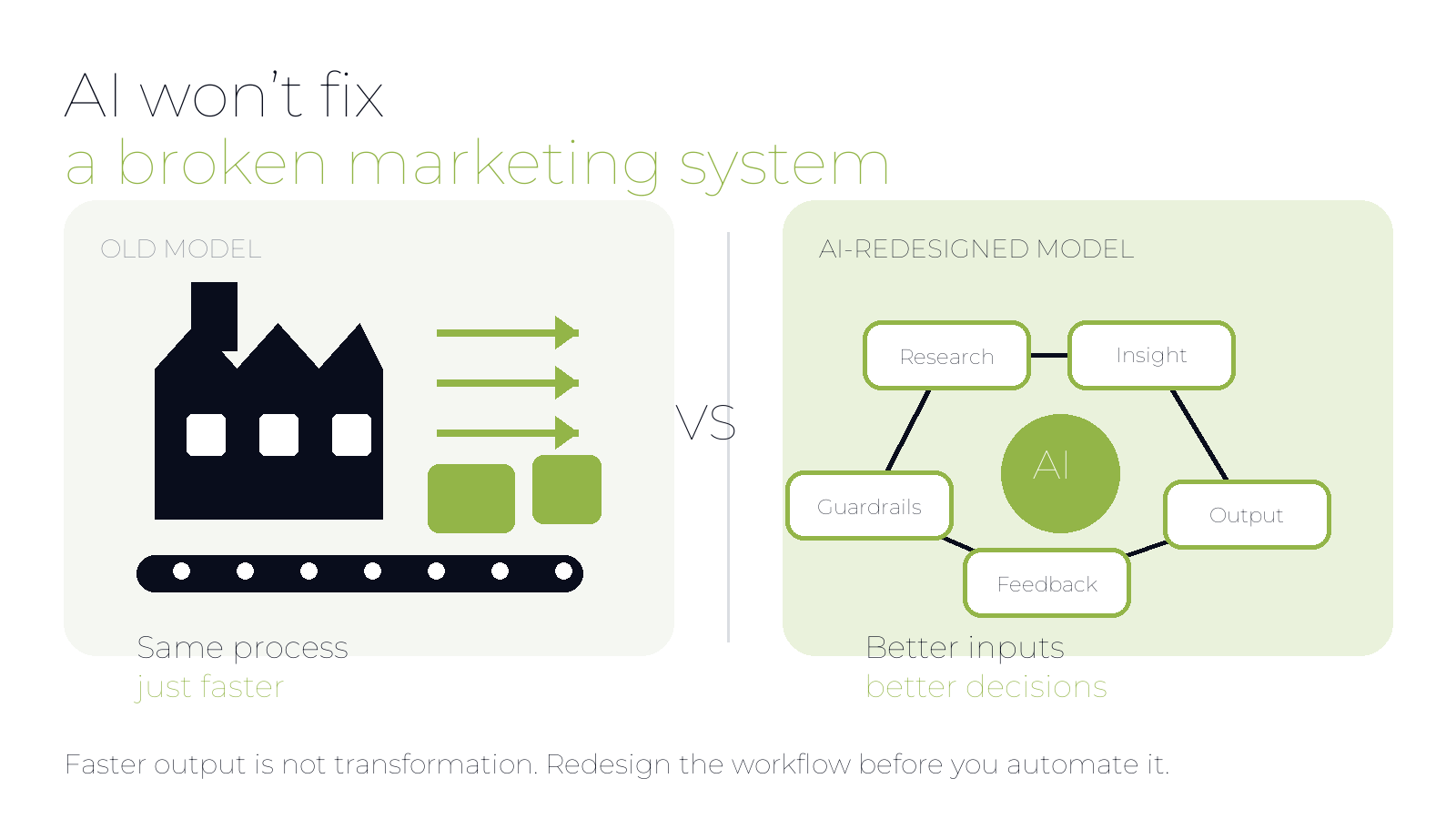
But all they’ve built is a faster factory.
Faster is not the same as better
Let’s take content.
The old workflow looked like this:
Pick a keyword
Write a brief
Draft an article
Edit it
Publish it
Hope it ranks
Now AI enters the picture, and most teams do this:
Pick a keyword
Ask AI for a brief
Ask AI for an article
Lightly edit it
Publish it
Hope it ranks
Same workflow.
Same assumptions.
Same blind spots.
Just faster.
That’s not a redesign. That’s automation layered onto an outdated process.
And it’s why so much AI-generated content feels flat. It answers a topic, but it doesn’t build authority. It sounds complete, but it doesn’t show real judgment. It fills the page, but it doesn’t move the buyer.
The problem isn’t that AI is weak.
The problem is that the system around it hasn’t changed.
The real opportunity is before the output
Most teams obsess over the final prompt.
“Write me an article about X.”
But the real value comes before that.
What research went in?
What customer insight shaped the angle?
What sales objections were included?
What competitor gaps were identified?
What Google already rewards on page one?
What AI platforms already recommend?
What original experience can the brand bring to the conversation?
This is where the game changes.
AI lets us collect, compare, structure, and challenge far more input material before we create anything.
You can feed the system:
customer calls
sales conversations
support tickets
product documentation
Google Search Console data
Google Analytics data
competitor pages
ranking pages
Reddit threads
YouTube transcripts
podcast interviews
expert notes
prior winning content
brand positioning
conversion data
Then you can build a loop.
Research → angle → draft → critique → improve → compare → refine → publish → measure → feed learnings back into the system.
That’s very different from “write this faster.”
That’s where self-improving workflows become possible.
AI should not just produce. It should challenge.
This is the part many companies miss.
They treat AI as a content generator.
I think that’s too narrow.
AI should also act as:
a research assistant
a pattern detector
a gap finder
a brief critic
a customer objection mapper
a competitor analyst
a quality reviewer
a search intent validator
a brand consistency checker
a feedback loop
The output should be the final step, not the starting point.
If you start with output, you get more content.
If you start with system design, you get better decisions.
And better decisions compound.
This matters even more for AI visibility
In classic SEO, a weak process could still produce occasional wins.
Pick enough keywords. Publish enough articles. Build enough links. Some things would rank.
That model is getting weaker.
Now we have Google, ChatGPT, Claude, Gemini, Perplexity, YouTube, Reddit, LinkedIn, and industry publications all shaping what buyers see before they ever contact you.
Visibility is no longer just “do we rank?”
It’s also:
Are we mentioned?
Are we recommended?
Are we cited as a trusted source?
Are we visible across the platforms buyers use?
Does the market associate us with the problem we solve?
Do AI systems understand what we do and who we’re best for?
This doesn’t get solved by publishing more generic content faster.
It gets solved by building a better authority system.
That means better research.
Better positioning.
Better source material.
Better distribution.
Better feedback loops.
AI can support all of this.
But only if someone knows how to design the system.
Guidance matters now
This is where I think many business owners and marketing leaders are underestimating the challenge.
They assume the AI journey is about tools.
Which tool should we use?
Which prompt should we write?
Which platform should we test?
Those questions matter, but they’re not the starting point.
The real questions are:
What should AI improve in our business?
Which workflows should we redesign instead of automate?
Where does human judgment need to be encoded into the system?
What inputs should AI use before producing an answer?
What feedback loops should improve the next version?
Where do we need speed, and where do we need better thinking?
Without guidance, teams default to speed.
And speed feels productive.
But if the direction is wrong, speed just gets you to the wrong place faster.
The takeaway
The companies that win with AI won’t be the ones producing more stuff.
They’ll be the ones redesigning how decisions get made.
They’ll stop asking:
“How can we do the same thing faster?”
And start asking:
“If we built this from scratch today, with AI available, what would we do differently?”
That question changes everything.
It changes content.
It changes SEO.
It changes reporting.
It changes strategy.
It changes how teams learn.
AI is not just a production tool.
Used properly, it’s a redesign opportunity.
And most companies haven’t taken that step yet.
That’s the opening.