


You spent hours writing that blog post. Maybe you hired someone to do it. You optimized it, published it, shared it on LinkedIn once.
Then... nothing.
So you write another one. Same result. And slowly, “content marketing doesn’t work for us” becomes the accepted truth inside your company.
Here’s what’s actually happening.
You built a stage but forgot the roads.
Content is not a publishing problem. It’s a distribution problem. And most businesses skip distribution entirely because they’ve been sold the idea that good content spreads on its own.
It doesn’t.
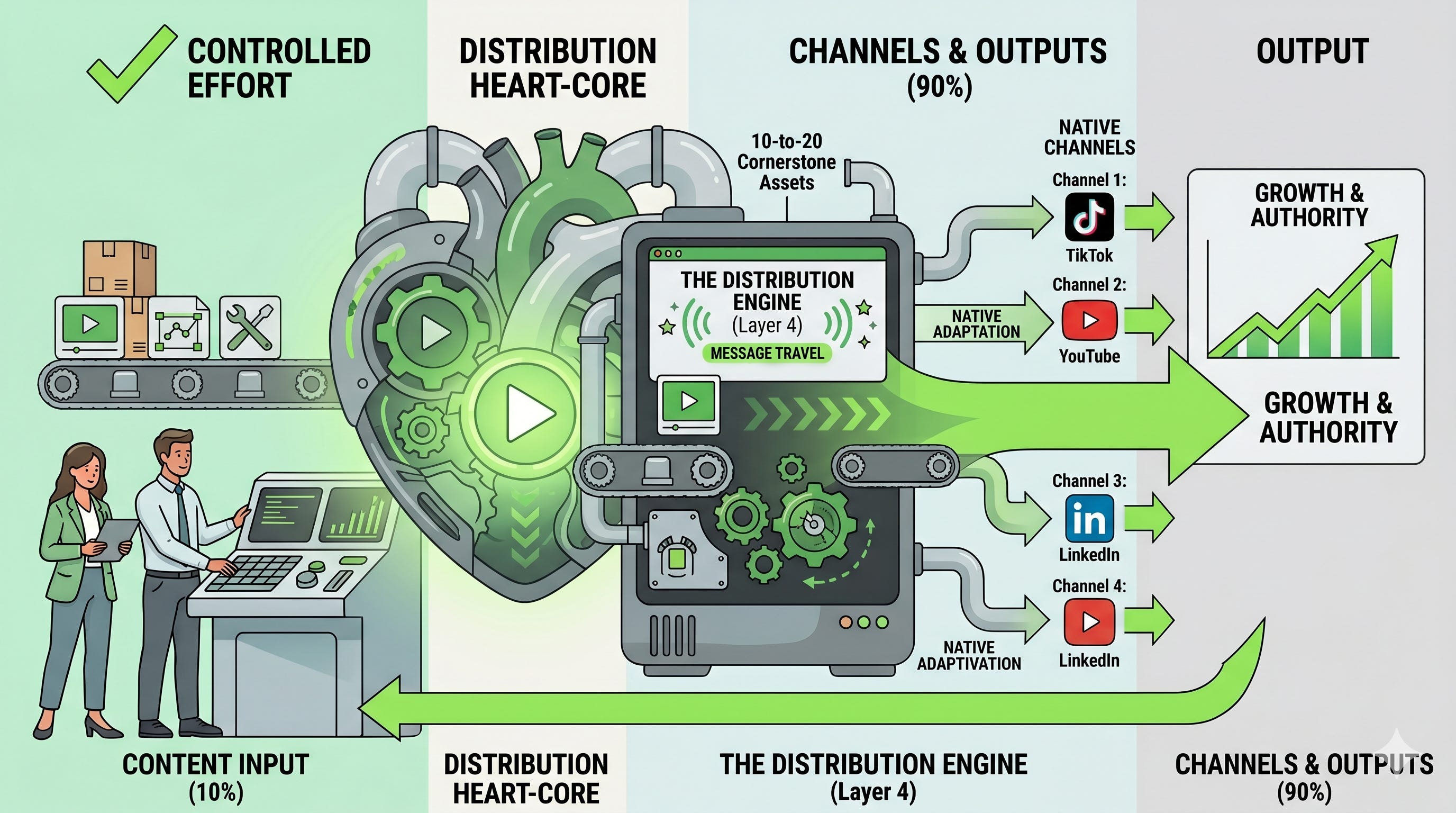
The layer most content strategies ignore
I’ve been building out what I call the SEvO Pyramid - Search Everywhere Optimization - a five-layer framework for getting found across every platform where your buyers actually spend time.
Most content advice starts at Layer 5: “create your own content.” Blog posts, videos, newsletters, podcasts. That’s where everyone starts because it feels productive.
But Layer 5 is the last layer for a reason. It only works when the layers beneath it are already in place.
Layer 4 is Distribution. And it’s the layer almost nobody builds.
What distribution actually means
Distribution isn’t “posting your article link on three social channels.” That’s broadcasting. Broadcasting is noise.
Real distribution is a system. It has four working parts:
1. Initial distribution
Identify the 4-6 platforms where your buyers actually consume content. Not where you’re comfortable posting. Where they’re paying attention. Send every piece of content into those channels within 24-48 hours of publishing, in the native format of each platform. LinkedIn wants a short punchy take. A Reddit community wants genuine contribution, not a link drop.
2. Format adaptation
One article becomes five assets. A blog post becomes a carousel. A podcast clip becomes a short video. A video transcript becomes a newsletter section. The idea travels. The format adapts.
3. Community distribution
There are communities (forums, Slack groups, Facebook groups, subreddits) where your buyers already gather. Become a real participant. Contribute answers. Then, when it’s genuinely useful, reference what you’ve written. Not as promotion. As a resource.
4. Evergreen reactivation
This is the one nobody does. Set up alerts (Google Alerts, social listening, community monitoring) for the topics you’ve written about. Every time someone asks a question your content answers, you respond with genuine value and point them to the resource. Your content keeps working instead of aging in a folder.
The conveyor belt model
Think of it this way. Most businesses treat each piece of content like a one-time event. Write it. Publish it. Move on.
But the goal is to build a conveyor belt. A structured, repeatable workflow where every piece of content moves through a sequence: initial channels, format adaptations, community placements, periodic reactivations. Not all at once. Not manually. Systematically.
A piece of content that enters that conveyor belt will reach your audience multiple times, on multiple platforms, in multiple formats, over multiple months. That’s compounding. That’s what makes content “work.”
The 10-20 rule
You don’t need a hundred pieces of content. You need 10 to 20 cornerstone assets - the pieces that capture your most important ideas, answer your buyers’ biggest questions, and reflect what you want to be known for.
Build those. Then run them through the distribution system. Reference them constantly. Let them become the anchors that everything else points back to.
Authority isn’t built by publishing more. It’s built by the same ideas being seen, repeatedly, by the right people, in the right places.
Where to start
If you’re creating content right now without a distribution system, stop adding new content for a month.
Instead:
Map the 4-6 platforms where your buyers actually are
Pick your 10 best existing pieces
Build a simple distribution workflow for each
Set up one or two topic alerts for evergreen reactivation
The content you already have can work a lot harder than it currently is.
The stage is built. Now build the roads!